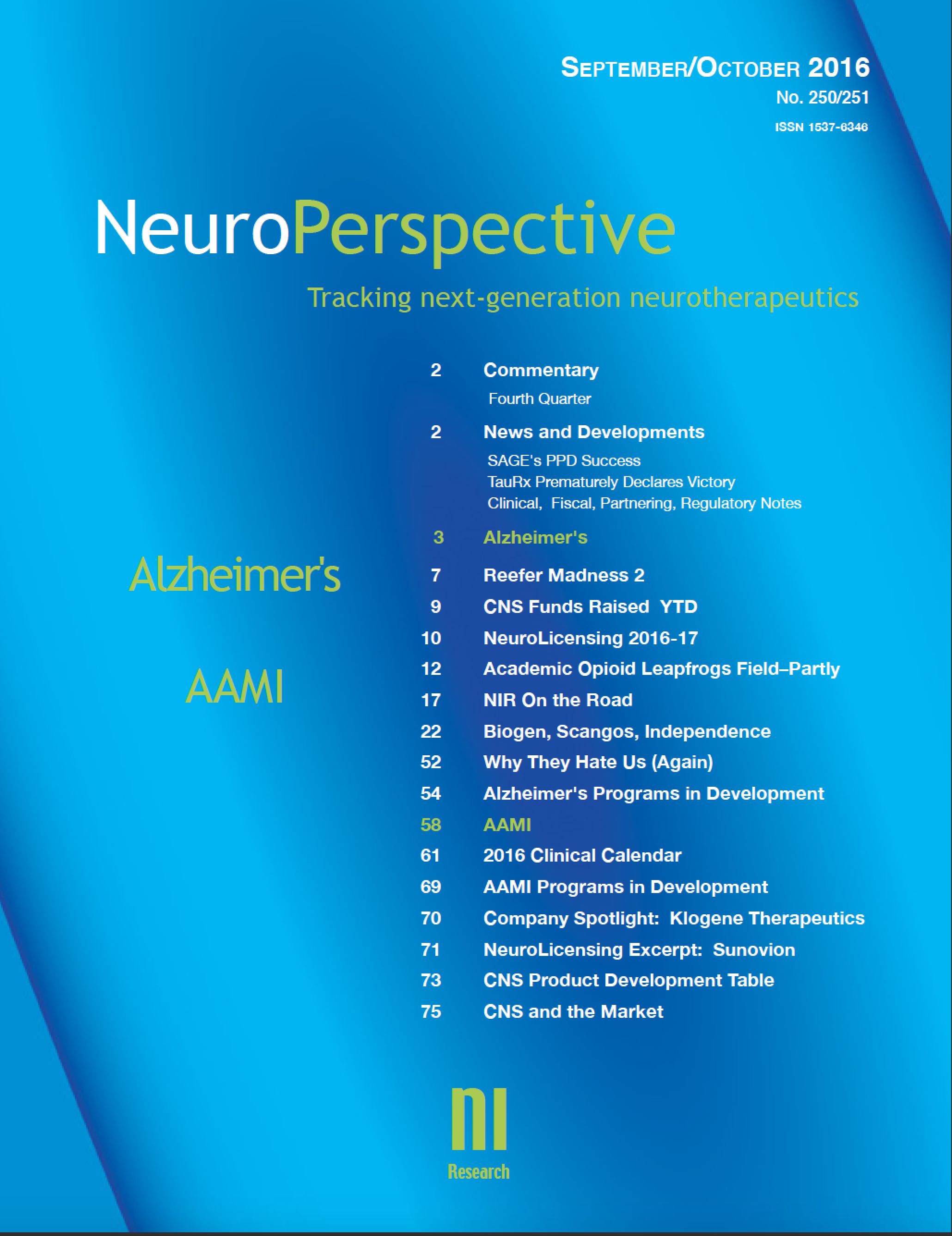
NeuroPerspective has released its Spring 2026 issue, featuring our reviews of PTSD, an area with expanding therapeutic possibilities: Autism, a fast- growing CNS disorder; and Epilepsy, where there have been several encouraging datasets in recent months.
Our review of PTSD recognizes trauma as a human growth industry: In theory, many traumatizing factors could be under human control, and yet human folly continues to generate new cases by the millions. Treatment tends to be psychotherapy-based, with pharmacotherapies comprised primarily of psychiatric meds treating PTSD-related mood, anxiety, and sleep disorders, without dramatic effect. But a new treatment paradigm is emerging: The recall of trauma memories, both cognitive and somatoform, brings them to the point of awareness, so that they are accessible first to deconsolidation, and then reconsolidation in affectively-neutralized form. It is during this window of accessibility that pharmacotherapy can reduce the degree of somatic hyperactivation, and perhaps enhance the process of overwriting the old ‘engrams’, or default mode, with a less retraumatizing ‘edition’ of history–the goal is not to erase history, but to stop reliving it. Procognitive pharmacotherapy may help with ‘rewriting’ of traumatic memories, and there are novel approaches, psychedelic and empathogenic, which rebuild maladaptive interpersonal patterns and ‘neutralize’ trauma-related affect. Psychedelic and empathogenic treatment options have shown tantalizing efficacy in human trials, including Resilient/Lykos’ MDMA studies and Compass’ pilot study of psilocybin in PTSD. Promising indicators have been seen in programs from Transcend (recently acquired by Otsuka) and Emyria, and AbbVie has cited PTSD as an indication of priority for the bretisolicin program licensed from Gilgamesh.
Autism also represents a burgeoning population, with prevalence estimates now reaching 3% of children. Autism has been turned into a battlefield in the current War on Science, with unfounded causal claims (e.g. vaccines) and unsubstantiated treatments being given undeserved credence, to the detriment of the field and patients with autism. This is an enormous, heterogeneous disorder whose genetic underpinnings are complex and multifactorial, save for relatively rare gene-driven disorders that partially overlap with autism, including Fragile X, Rett Syndrome, and Phelan-McDermid Syndrome. The underlying biology appears to include malfunctioning neuronal network growth and subsequent ‘culling’. Specific treatments, including gene therapy, are in development for the rare subvariants, and for idiopathic autism, the search is on for improved symptomatic-treatments addressing irritability, social disengagement, and sleep disorders, even as work continues on identifying more homogenous subgroups who could have upstream pathway disruptions remediated. Trials of R-MDMA (Definium), muscarinic activation (Bristol Myers Squibb), epigenetic intervention (Oryzon), serotonergic upregulation (Maplight) are among those underway or approaching.
Epilepsy decades ago was the reliquary of anachronistic drug treatments whose side effect profiles were daunting: Idiopathic epilepsy has seen improvement in the anti-seizure options, but there is still a substantial subgroup of patients whose epilepsy, usually focal in nature, is treatment-refractory. Considerable progress has been made in addressing genetically-driven, rare but devastating pediatric seizure disorders, such as Dravet Syndrome, Lennox-Gastaut, Tuberous Sclerosis, and the umbrella category of Developmental Epileptic Encephalopathies. Companies like Praxis and Xenon have had significant clinical successes, Phase III trials are underway for programs from Biohaven, Stoke, Encoded, Lundbeck, Harmony, Neurvati/GRIN Therapeutics, and Neurona, while earlier stage programs with promise are ongoing for Rapport Therapeutics and Jazz/Saniona.
The Spring Issue also includes the Psychedelic Update, assessing datasets from Compass, AtaiBeckley, Gilgamesh, Helus/Cybin, and Johns Hopkins, which in aggregate continue to add substance to the explosion of interest in this area. Positive datasets outside of Psychedelics are reviewed, from Lundbeck, Xenon, and QurAlis. Prominent transactions are discussed, including Korsana’s reverse merger, Lilly’s acquisition of Centessa, Xenon’s mega-stock offering, and more. The Company Spotlight overviews Synchronicity Pharma.
NeuroPerspective is the quarterly review of the neurotherapeutics area offering essential, unique, and comprehensive coverage of developments in the science and the business of the CNS sector. A one-year (1-5 user) subscription is $3400. A 6-10 user subscription is $5600. Other customized user base and startup pricing options are available. The 63 page Spring issue is available as a single issue purchase, US$900.