The Winter (January/February/March) 2022 issue of NeuroPerspective has been released. It provides a comprehensive review of 2021, a year that provided very little in the way of respite, though funding by institutional investors and partners came in third all-time, behind 2018 and the remarkable 2020. Partnering upfront payments were off 38% from 2020, institutionalization investment was down 28%. Neurodegeneration and Psychiatry continued to be the dominant sub-areas for investors.
There were some notable achievements and failures clinically, with the former including successes in the nascent but booming Psychedelics area from Compass and MAPS, underappreciated success for a stroke drug now partnered by Biogen, success in the Rett’s PhIII trial for Acadia/Neuren, and impressive results for Biohaven‘s zavegepant in acute migraine. No disappointment stood out more than the failure of Roche/Ionis‘ tominersen in Huntington’s which served as a reminder that even when there is a clear genetic target and payload, gene therapy is more challenging than some observers seem to have assumed. Accordingly, the valuations of several formerly high-flying gene therapy companies were significantly down during 2021.
Other highlights and Lowlights from 2021 are assessed. 2021 saw the advent of some very well-funded umbrella companies seeking to emulate the Bridge Bio model in CNS, including Neumora and Neurvati. One underappreciated dynamic is the return of some Big Pharmas to the neuro sector that had previously departed: GSK and Bristol Myers Squibb spent more than $800 million in neuro partnership upfront payments in 2021. Biogen in 2020 had been a high-profile acquirer of external resources, but in 2021 was more noteworthy for mistakes made, with the resurrection of Aduhelm/aducanumab constituting something far less than a regulatory gift, it has turned out to be a trap. Biogen will not benefit from the FDA’s largesse, but some other amyloid antibody programs, from Lilly, Eisai/Biogen, and Roche, most likely will. Alzheimer’s was also the area where fragmentary, preliminary clinical ‘data’ fueled dramatic swings in investor sentiment for companies like Cassava and Annovis. This just sets the stage for a gathering flood of clinical datasets, in neurodegeneration and other areas, that will come between 2022 and 2024..
30% of all institutional investment in Psychiatry went to companies pursuing the development of Psychedelics as novel approaches to Psychiatry. But while almost $600 million was invested, even a company with positive clinical data, like Compass, found its valuation plummeting. The Psychedelics Update section of the Winter issue looks at developments in this sector and some of the higher profile companies within it, like Compass, Atai, MindMed, GH Research, and others.
120+ companies have capsule summaries of current activities and coming events, including AbbVie, Acadia, Alector, Aptinyx, Atai Life Sciences, Athira, Annovis, Axsome, Biogen, Biohaven, Cassava, Cortexyme, Denali, EIP, Harmony, Karuna, Lilly, Lundbeck, Marinus, Minerva, Neurocrine Biosciences, Novartis, Roche, Sage Therapeutics, Sunovion, Takeda, UCB, Xenon, and many more.
NeuroPerspective is now a quarterly review of the neurotherapeutics area offering unique and comprehensive coverage of developments in the science and the business of the CNS sector. 1-5 reader subscriptions are US$2950 per year, 6-10 user subscriptions are $4950.
NI Research has released the November/December 2021 issue of NeuroPerspective, which features comprehensive reviews for two major neurodegenerative disorders: Parkinson’s and ALS. These reviews include a consideration of the current thinking around pathophysiology and therapeutic targets, including the protein aggregates considered to be associated with these disorders: Alpha-synuclein, TDP-43, SOD1, and c9orf72. Neuroinflammation, GBA as a target, LRRK2, the gut-brain microbiome, autophagy, and other mechanisms of current interest are included.
The Parkinson’s review includes 130+ programs, including programs from AbbVie / Mission, AC Immune, Annovis, Bayer, Aspen Neuroscience, BIAL Bio, Biogen, Cantabio, Caraway, Casma, Denali, Roche/Genentech, Lundbeck, Neuropore, Prothena/Roche, Sage Therapeutics, UCB Pharma, Vanqua, Axial Biotherapeutics, Yumanity, and Cerevel. The ALS review includes 85+ programs, including Amylyx, Biogen/Ionis, Sanofi/Denali, GSK/Alector, Neuropore, Libra, Locana, Neurimmune, Prilenia, QurAlis, and Verge Genomics.
QurAlis is the focus of the Company Spotlight. Sidebars include and overview of the burgeoning roster of CNS portfolio companies (e.g. Neumora, Neurvati, Cambrian, Atai); developments in Alzheimer’s, including results from Cortexyme, AC Immune, and Cassava. Our Psychedelic Update section assesses Pasithea‘s revenue-generation plan as well as developments at Atai/DeMeRx, Field Trip Health, and MindMed. 66 pages.
NI Research is the leading publisher of independent research on the neurotherapeutics industry, and has developed an unmatched information base regarding both publicly and privately held CNS companies. The November/December review of PD and ALS culminates a two-issue sequence on neurodegeneration, with the September/October 2021 issue having comprehensively covered Alzheimer’s and Huntington’s.
NeuroPerspective is the authoritative, independent, monthly review of the neurotherapeutics area, providing critical analyses of therapeutics-in-development. A one-year (1-5 user) subscription to NeuroPerspective is $2900. A 6-10 user subscription is $4950. Other customized userbase and startup pricing options are available. The Parkinson’s/ALS review issue of NeuroPerspective is available as a single-issue purchase for $700.
The September/October issue of NeuroPerspective has been released. It features our comprehensive annual review of the Alzheimer’s space, including an assessment of the current conceptual trends vis-a-vis pathophysiology and therapeutic targets. One major theme is the resuscitation of the amyloid antibody space by the FDA, led by Biogen‘s Aduhelm. But Biogen, due partly to their gross misreading of the cost environment, may not be the major beneficiary of the FDA’s abdication of its role in quality control: Lilly‘s donanemab may well be the next Accelerated Approval in the Alzheimer’s space, its main role, other than being a slightly less mediocre aducanumab, will be to provide competition and drive down pricing in this nascent market.
Hopes for tau as a target for monoclonal antibodies have been largely dashed, a judgment unchanged by AC Immune‘s fluky finding on one cognitive endpoint on one out of two trials. The revival of the amyloid hypothesis will divert resources and patients from clinical trials for other therapeutic targets, the most promising of which tend to be in the neuroinflammation and cellular waste disposal categories. The neuroimmunological space has just started to mature, with clinical stage programs underway from Denali/Sanofi and Alector/AbbVie. This type of midstream focus offers the prospect of disease modification without having to precisely identify the upstream molecular culprit that initiates the disease process. Cortexyme has done its correlational homework for the p.gingivalis hypothesis, in the next four months it will be clear whether there is a causal link to AD and an antibiotic solution. There are also a slew of small companies whose programmatic execution is sloppy and their hyperbole excessive, with Cassava and Annovis prominent in that group.
Among the 200+ programs assessed are those from: AbbVie/Alector, AC Immune, Anavex, Athira, Axon-Neuroscience, Biogen, Casma, Cognition Therapeutics, Cortexyme, Denali, Eisai, Lilly, Roche, Syndesi, TauRx. There is coverage assessing prospects for further Accelerated Approvals.
The issue also includes a full review of Huntington’s, the landscape having been transformed by the failure of the first wave of ASO programs from Roche/Ionis and Wave/Takeda. UniQure, Triplet, Voyager, and Prilenia are among the other companies reviewed.
The September/October issue includes a focused review of ParosBio and their gene therapy program for autosomal dominant Alzheimer’s. Our Psychedelics update section notes developments for Beckley Psytech and ATAI, and the implications of legislative movement in Oregon and California, which yields as much risk as opportunity.
The Alzheimer’s/Huntington’s issue is being made available for single-issue purchase: $700.
The July/August 2021 issue of NeuroPerspective begins with the Mid-Year Overview of the neurotherapeutics sector. It includes extensive coverage of and commentary about the FDA’s dramatically negligent approval of Biogen’s Aduhelm/aducanumab, negligent because of its disregard for its own ADCOM recommendations, omission of even basic limitations on labeling and REMS requirements. Other news coverage includes the mixed finds for Biogen/Sage‘s zuranolone, albeit with the bottom line that there may be a niche depression population for which zuranolone might be a preferred options; new partnerships for AbbVie; continued investor enthusiasm for the burgeoning area of Psychedelic therapies, made tangible by ATAI‘s highly successful IPO; Cerevel‘s PhIb success with its M4 agonist; and the tragic turn of events for the Huntington’s community in the wake of tominersen’s failure in PhIII. An update on the Psychedelics area is included, as are capsule summaries of progress at 150+ CNS companies, including AbbVie, Annovis, Athira, Axsome, ATAI, Biogen, Cassava, Cerevel, Lilly, MindMed, Minerva, Neurocrine, Novartis, Oryzon, Roche, Sage, Sosei Heptares, Tonix, UCB, and UniQure. The Company Review assesses Longboard Pharmaceuticals.
The second section of the issue features a comprehensive review of Addiction, NeuroPerspective’s first since 2018. Addiction continues be a curious and disturbing contradiction, almost completely neglected by the pharma industry despite its worldwide prevalence and toll taken, and the extensive press coverage of such dire events as the American ‘Opioid Epidemic’. There is a surfeit of hand-wringing and blame-placing, but little more than window-dressing when it comes to providing tangible resources . NIDA has done exemplary work in keeping the lights on for Addictions research, but hardly at the scale necessary given the scope of the disorder. This review details the neurophysiology and therapeutic approaches to opioid addiction, and its substance abuse siblings: Alcohol, Nicotine, and Stimulants (cocaine and methamphetamine). Promising novel target systems are appraised, including orexin, GPR139, HDAC2, and potential psychedelic approaches, including ibogaine and its derivatives. Therapeutic programs from AstraZeneca/Eolas, Cerevel, Delix, Embera, InterveXion, MindMed, Indivior, MediciNova, and Opiant are among those reviewed in the review.
NeuroPerspective has released its May/June 2021 issue, featuring comprehensive reviews of neurotherapeutics programs addressing Schizophrenia and Multiple Sclerosis.
The Schizophrenia area has been relatively static since the field became dominated by Second Generation (‘atypical’) antipsychotics. Efforts to widen the range of symptoms effectively treated to include cognitive and negative symptoms have generally fallen short. But there are novel mechanisms now maturing that may offer a viable alternative for positive symptoms, and some, singly or as adjuncts, that may finally chip away at cognitive/negative symptomatology. Still in relative infancy are efforts to remediate the underlying synaptic connectivity issues that epitomize the neurodevelopmental nature of schizophreniform illness. Broad-spectrum options still in clinical testing include Sunovion’s TAAR1 inhibitor, SEP-363856, and Karuna Therapeutics’ KarXT, both in PhIII. Some of the promising programs specifically for cognitive/negative symptoms in the clinic come from Syndesi, Neurocrine Biosciences, Novartis/Cadent, Boehringer Ingelheim, and Biogen. Neurostructural interventions that might have a disease-modifying component tend to be earlier on, though Oryzon Genomics has their epigenetic modulator vafidemstat in PhII.
Multiple Sclerosis is, in contrast, the CNS disorder where disease-modification options (for RRMS) have multiplied in type and profile, so that patients now have a range to choose from. The CD20-targeting drugs were the first category that did not require a trade-off between efficacy and safety. BTK-inhibitors may be the next major category to emerge (Sanofi, Merck Serono, Roche), and there is ample energy going into regenerative/remyelinating programs (AbbVie, NervGen, Autobahn, Roche/Inception 5, and Biogen, to name but a few. Progressive MS has been a more challenging disease venue, but the BTK inhibitors and a program from Atara bear watching.
The issue also includes a Company Spotlight appraisal of Autobahn Therapeutics; an assessment of Acadia’s CRL for pimavanserin in dementia psychosis, and disappointing results for two high-profile Huntington’s programs, from Roche/Ionis and Wave Life Sciences.
A one-year (1-5 user) subscription to NeuroPerspective is $2900. A 6-10 user subscription is $4950. Other customized userbase and startup pricing options are available. The May/June issue covering Schizophrenia and MS is being made available as a single-issue purchase, for $600.
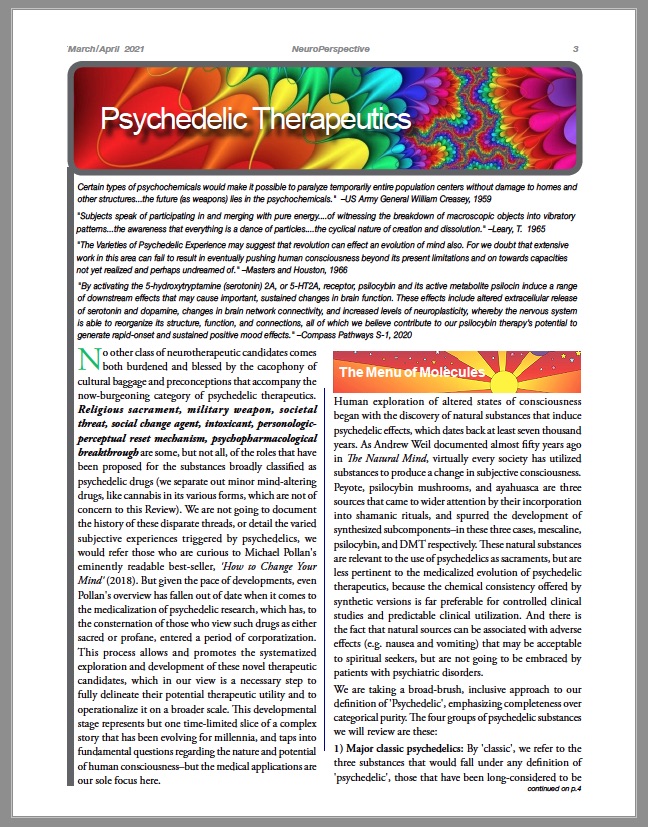
NeuroPerspective has released its March/April 2021 issue, featuring its first-ever, comprehensive review of the rapidly-expanding Psychedelic Therapeutics space, where substances formerly relegated to sacramental and/or illegal status are being formally tested as treatments for CNS disorders. Psilocybin, LSD, DMT, 5-MeO-DMT are some of the ‘classic’ psychedelic substances being explored, along with ‘empathogens’ like MDMA, dissociative drugs like ketamine, esketamine, arketamine, and a few substances less easily categorized, like ibogaine and its derivatives.
There is already substantial clinical support for their use in PTSD (where MAPS has had a successful PhIII trial), Treatment-Resistant Depression (Compass Pathways currently is running a PhIIb study), Cancer-related Pain/Anxiety, and Addictions. Other areas, like Eating Disorders, Phantom-Limb Pain, Cancer Pain and intractable migraines, and even cognitive disorders like ADHD and Alzheimer’s, are being assessed for the potential usefulness of psychedelics.
The Review assesses close to fifty companies involved in psychedelics research: Including MAPS, Compass Pathways, ATAI Life Sciences and its panoply of partnered programs (Viridia, Perception Neuroscience, DeMeRx, Entheogenix, EmpathBio); MindMed, Beckley Psytech, Field Trip Health, MindCure, Diamond Therapeutics, MYND, Gilgamesh Pharma, Cybin, PsyBio, Small Pharma, Mindset, Tactogen, Usona Institute, Entheon Biomedical, Eleusis, and many more. These companies cover the gamut of skillsets and viability, from well-founded to ephemeral pipedreams. The rationale for psychedelic mechanisms (e.g. classic 5HT-2a binding, impact on default mode networks) are reviewed, factors governing the path forward for the class are examined in detail.
The issue also includes a Company Spotlight appraisal of MindMed; an assessment of the aducanumab PDUFA extension, and coverage of six Alzheimer’s programs and their clinical status, including Cassava Sciences, Cortexyme, Lilly, and Biohaven.
43 pages.
NI Research is the leading publisher of independent research on the neurotherapeutics industry, and has developed an unmatched information base regarding both publicly and privately held CNS companies.
A one-year (1-5 user) subscription to NeuroPerspective is $2900. A 6-10 user subscription is $4950. Other customized userbase and startup pricing options are available. The March/April issue covering Psychedelic Therapeutics is being made available as a single-issue purchase, for $750.
NI Research has also just released the 2021 edition of NeuroLicensing, which comprehensively reviews current licensing trends in the CNS area, and assesses large and midsize pharma companies in terms of their licensing agendas and performance.
For additional information and online purchasing with immediate downloads, enter the Publication Store shown above this section.