NI Research is pleased to announce the release of NeuroLicensing 2021
The indispensable guide to:
Current trends in deal parameters
Pharma track records in CNS licensing
What each company is looking for in terms of therapeutic areas and stages of development
NIR’s candid evaluations of pharma performance and capabilities
NeuroLicensing 2021 is a vital and affordable resource for licensing teams on both sides of BD transactions. Completely revised and updated, NL 2021 provides a unique and frank perspective on the major and midsize companies who are most involved in CNS licensing. Opportunities and partnering agendas are appraised, caution flags raised where warranted, trends in terms and emphases detailed. To order, go to the Publication Store button above, NeuroLicensing 2021 is available for instant download.
104 pages US$4200
Read More
The January/February 2021 issue of NeuroPerspective has been released. It provides a comprehensive review of 2020, a year that was horrific in the global sense, but surprisingly positive within the neurotherapeutics category; and a candid appraisal of what to anticipate in 2021, a year that will have a number of high-interest datasets coming, but is unlikely to match 2020’s record-setting flow of fiscal resources into the sector.
Highlights and Lowlights from 2020 are assessed, with a high-profile for Biogen in particular. Biogen accounted for 76% of all partnership upfront in 2020, with major deals with Sage Therapeutics and Denali Therapeutics leading the way, but Biogen also made the tactical error of erasing the sponsor/Agency boundary in its aducanumab ADCOM presentation, creating a conflict of interest that hardened the opposition to aducanumab’s already troubled application. Sage had to abort Zulresso’s nascent launch, but ended the year on the high-note of the Biogen partnership. Lilly made some bold moves to expand its neurodegeneration pipeline (via Prevail and Disarm Therapeutics); Neurocrine and Acadia continued to build portfolios fueled by progress with their commercialized assets. Procognitive drugs have finally started to make their mark clinically (Tetra/Shionogi, Boehringer Ingelheim, Aptinyx, Sage), and the new era for psychedelic therapies saw Compass Pathways go public, and Atai Life Sciences complete a major funding round.
On the other hand, the early returns on tau therapeutics raise significant doubts as to the impact of attacking extracellular tau, which raises the profile for programs addressing intracellular tau (Biogen/Ionis, Lilly/AC Immune).
120+ companies have capsule summaries of current activities and coming events, including AbbVie, Alector, Alkahest, Alkermes, Aptinyx, ATAI Life Sciences, Axial Biotherapeutics, Axsome, Biogen, Biohaven, Blackthorn, BrainStorm, Centrexion, Cortexyme, Denali, EIP, Intra-Cellular, Karuna, Lilly, Lundbeck, Marinus, Minerva, NervGen, Neurocrine Biosciences, Noema, Novartis, Oryzon, Ovid, Roche, Sage Therapeutics, Sunovion, Takeda, UCB, Voyager Therapeutics, Wave Life Sciences, Xenon, Yumanity, Zogenix, and many more.
The Jan/Feb NP also overviews the multiple factors impacting prospects for Biogen‘s aducanumab NDA; provides detailed assessments of the allocation of investor and partnership resources by therapeutic area; and discusses the Analytic Myopia that plagued some appraisals of the Biogen/Sage deal. marathon and the pharmacotherapy of Borderline Personality Disorder.
The Company Spotlight covers Libra Therapeutics, developing a portfolio of compounds spun out by Axxam.
41 pages.
Read More
The November/December 2020 issue of NeuroPerspective reviews Autism Spectrum Disorder. The nomenclature itself is a confession of conceptual sloppiness; ASD is a vaguely defined umbrella category, under which huddles a highly heterogeneous assortment of phenotypic presentations, divergent in their type, intensity, and prognosis.
ASD is always impactful, and it can be devastating on several levels, though that depends on where it falls on the range of developmental disruption. At the micro-familial level, few events are likely to be more painful for parents than to slowly learn that the kind of intense attachment they feel for a child may never be fully felt or expressed in return. At the macro-societal level, the prevalence of autism in its multiple manifestations has exploded, with the latest estimate, in 2018, reaching one of every 59 children in the United States, up from one in 68 just four years ago, up twenty-fold over the past three decades. No other disorder has displayed anything near this kind of dramatic growth in sheer numbers. Approaches range from nonspecific efforts to reduce hyperstimulation or boost cognition to thus-far frustrating attempts to access the oxytocin-vasopressin axis, modulate the gut-brain microbiome, or find gene regulators that may impact gene networks that might permit broadband interventions. Gene therapies are more directly applicable to the second group of neurodevelopment disorders covered in the issue; Rett Syndrome, Fragile X, Angelman Syndrome, where monogenic targets are apparent, though each appears to involve a narrow therapeutic window, its viability as yet unproven.
Companies whose programs are included in the review include Janssen, Roche, Novartis, Acadia, Neuren, Ovid Therapeutics, Taysha Gene Therapies, Axial Biotherapeutics, Kaerus Biosciences, Sangamo, Biogen/Ionis, Ultragenyx/HealX, and Servier/Neurochlore.
Other clinical topics covered in the issue include the failure of the first tau antibody in Alzheimer’s (Genentech/AC Immune), ambiguous Parkinson’s results from Roche/Prothena‘s alpha-synuclein antibody, clinical successes for Aptinyx and Intra-Cellular Therapies, and overhyped data for Cassava and Amylyx. Corporate developments assessed include BIAL’s acquisition of Lysosomal Therapeutics, four more small neuro companies going public, and a continuing flow of fiscal resources into the sector.
Read More
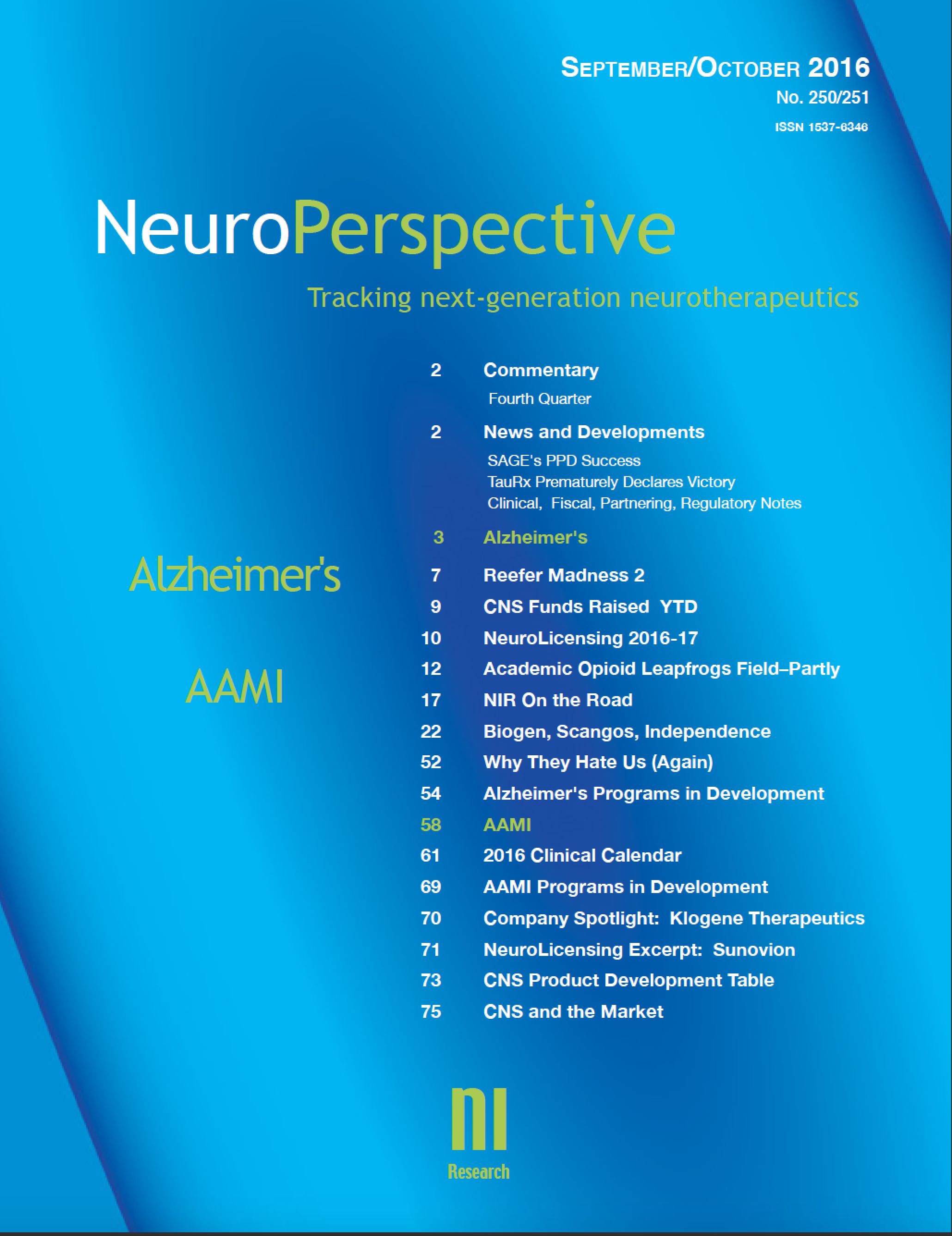
The September/October issue of NeuroPerspective has been released. It features our comprehensive annual review of the Alzheimer’s space, including an assessment of the current conceptual trends vis-a-vis pathophysiology and therapeutic targets. Aducanumab has somehow survived at the head of the regulatory menu, its prospects are discussed at length. Despite the early disappointments in PSP, tau therapeutics are now in the spotlight as they begin to produce data. The neuroimmunological space has started to mature, with clinical stage programs underway from Denali/Sanofi and Alector/AbbVie, and this type of midstream focus offers the prospect of disease modification without having to precisely identify the upstream molecular culprit that initiates the disease process. Cortexyme will have an interim analysis in the next few months that will give a first look at the potential impact of this infection-based paradigm.
Among the 200+ programs assessed are those from: AbbVie/Alector, AC Immune, Alkahest, Anavex, Athira, Axon-Neuroscience, Biogen, Cognition Therapeutics, Cortexyme, Denali, Eisai, EIP Pharma, Grifols, Lilly, Oryzon, Roche, Syndesi, TauRx, and Voyager. Sidebars include coverage of the current state of the AD Biomarker art and an overview of the POC timelines for major AD programs.
The issue also includes a full review of Frontotemporal Dementia (FTD), including a breakdown of the complex heterogeneity within this umbrella category, with marked divergences in genotype and phenotypic signs. FTD-PGRN has emerged as a particular subset of interest, with progranulin enhancing programs in development by Alector, Arkuda, Passage Bio, and Prevail, amongst several.
The September/October issue includes a focused review of Prevail Therapeutics as well as coverage of the extremely busy funding and partnering season, which has seen a number of companies taking diverse routes to the public markets, including Cerevel, Harmony Biosciences, and Yumanity, with Compass Pathways and Athira Pharma on the runway.
78 pages.
Read More
The July/August 2020 issue overviews developments in the neuro sector YTD, including a number of partnerships, including the Takeda/Neurocrine alliance; a robust funding environment for small companies, including Athira, Prilenia, Engrail, Autobahn, QurAlis, Atara,and Aspen Neuroscience. Capsule summaries for 80+ companies are included, plus commentary regarding trends in investment and partnership dynamics. TBI is reviewed in full, but while biomarker work has been productive, there has been a paucity of therapeutics-in-development. The July/August issue also provides an overview of Praxis Precision Medicines.
Read More
The May/June 2020 issue of NeuroPerspective has been released, featuring in-depth reviews of Depression and PTSD.
Depression represents a glaringly incomplete success for psychopharmacology. The majority of patients do not find adequate relief from their first trial, and 25% do not find sufficient benefit from any of the antidepressants they try. Aversive side effects, including weight gain and sexual dysfunction, form a significant barrier to utilization, and the long delay to relief is counter-therapeutic. There have been advances and disappointments in the search for a Rapid-Acting-Antidepressant, the much-publicized utilization of off-label, IV ketamine echoed by JNJ’s success in developing intranasal esketamine, with the counterpoint of Allergan’s emphatic Phase III failure with rapastinel, which had seemed so promising. There are several programs that seem to have potential as RAADs, with positive efficacy findings from Axsome, Relmada, and Sage Therapeutics, though Sage’s zuranolone has not yet established the kind of durability that would make their intermittent dosing paradigm viable. Compass Pathways’ psilocybin program is now in PhII, offering what could be a rapid reset of a patient’s view of self and relationships. The almost ubiquitous prevalence of sexual dysfunction as a consequence of depression and SSRI/SNRI has been a significant deterrent to treatment and compliance, with glutamatergic drugs-in-development appearing to avoid this AE, and Fabre-Kramer’s Travivo demonstrating a beneficial impact on sexual functioning. Other antidepressant programs discussed in the review include those from Acadia Pharmaceuticals, ATAI/Perception, Blackthorn, Minerva Neuroscience, Navitor, and Novartis/Cadent.
PTSD (Post-Traumatic Stress Disorder) has once again risen in profile, this time as a result of the Covid-19 pandemic, another example of trauma born of both natural (tsunamis, firestorms) and human-made (combat, mass shootings, sexual/physical abuse) calamities. Therapeutic interventions can be focused upon attenuating the limbic system hyperactivation of PTSD and/or accentuating the cognitive rewriting of traumatic memory in a reconsolidation paradigm. The pharma industry has generally taken a passive approach to PTSD, leaving the funding of research to the DoD and VA in the US, but small companies are working in this undertreated and very large-scale domain, including Aptinyx, Azevan, and Nobilis. Tonix Pharma has emphasized PTSD in its persistently unsuccessful development programming.
The May/June issue also examines a flurry of recent data disclosures, with critical scrutiny of Axsome’s results in Alzheimer’s-agitation; Axon-Neurosciences’ long awaited Alzheimer’s data; and results from Roche, Lundbeck, and NoNO, the latter showing potential in ischemic stroke despite its trial failure. Supernus has finally broadened its portfolio, most importantly with its Navitor partnership. The impact of the Covid-19 pandemic on CNS drug development is considered, with data from AiCure, IQVia, and others regarding trial enrollment and compliance effects. The pandemic has thrown a major obstacle in the path of new drug launches, particularly disrupting Sage’s launch of Zulresso, threatening Intra-Cellular’s Caplyta introduction, and causing Neurocrine to postpone the launch of Ontgenys.
The Company Spotlight overviews ATAI Life Sciences and their creative portfolio of unorthodox therapies for depression, anxiety, and addiction, wherein their stewardship of Compass Pathways’ work stands out as relatively more conventional.
Read More