The March/April 2019 issue of NeuroPerspective has been released, offering detailed reviews of two therapeutic areas, as well as coverage and commentary regarding significant developments in the CNS therapeutics space.
The first therapeutic sector review covers Schizophrenia, the most devastating of all the psychiatric disorders, one which comprises the awkward melding of multiple schizophreniform phenotypes with very divergent symptom patterns. Affecting about 1% of the population, schizophrenia’s genetic vulnerabilities are complex and contribute to schizophrenia’s etiological confluence of genetic flaws, prenatal/perinatal environmental factors, and later anomalies in the formation and ‘editing’ of synaptic networks. At its root, schizophrenia most likely arises from neurodevelopmental failure exacerbated by the degenerative impact of aberrant adolescent synaptic ‘pruning,’ perhaps reflecting aberrant neuroinflammatory/immune system activity. Network deficits account for the neural dyscontrol that sets the stage for hallucinations/delusions, and for the impoverishment of cognitive capabilities and motivation. While there is promising work on neuroinflammation currently ongoing, with a predominant focus on neurodegeneration (e.g. Alector, Annexon, Denali), the potential application of that work to schizophrenia lags far behind. Symptomatic treatments for schizophrenia are still the currency of the clinical practice and clinical development realms: Current therapeutics are almost solely aimed at the so-called positive symptoms of schizophrenia, there has been no real success developing treatments for the cognitive and negative symptoms that take such a functional toll, even when the more florid symptoms of schizophrenia are relatively controlled. Some of the companies whose programs are discussed in the review include: Biogen,Intra-Cellular Therapies, Karuna Pharmaceuticals, Cerevel, Allergan, Boehringer Ingelheim, Sage Therapeutics, Lundbeck, Takeda, Acadia, Promentis, Newron, Syndesi, SyneuRx, and Sunovion.
The second therapeutic sector review covers Stroke, an area which became anathema to the pharma industry after a series of clinical failures 15-20 years ago. With almost 800,000 stroke cases annually in the US alone, this neglect (which had left stroke R&D primarily the province of endovascular device companies) has been untenable in the long run. Biogen is the first of the major pharma companies to make a return to stroke, via partnerships with Remedy and TMS. There is work on extending the window for thrombolytic interventions (ActiCor, Biogen), solving the seemingly intractable puzzle of neuroprotection (NoNO, AdMIRx, Avilex, ZZ Biotech), and a growing emphasis on repair/regeneration, particularly by the several cell therapy companies engaged in that work (Athersys, SanBio, NeuralStem, ReNeuron). Programs from BioAxone and Idorsia address hemorrhagic stroke. Other companies and academic centers whose programs are discussed in this review include: UCLA, ArunA, NeurOp).
The March/April issue also includes discussion of recent clinical findings from companies addressing depression (JNJ/Janssen, Sage Therapeutics,Axsome, Blackthorn Therapeutics); high-innovation partnerships for Voyager with AbbVie and with Neurocrine, Biogen with C4T and Skyhawk, and possible salvation for the PTSD program from Bionomics. The Company Spotlight Review covers SyneuRx, which is in PhII/III trials using sodium benzoate/NaBen for schizophrenia and dementia.
NI Research is the leading publisher of independent research on the neurotherapeutics industry, and has developed an unmatched information base regarding both publicly and privately held CNS companies. NeuroPerspective is the authoritative, independent, monthly review of the neurotherapeutics area, providing critical analyses of therapeutics-in-development.
A one-year (1-5 user) subscription to NeuroPerspective is $2800. Special startup, nonprofit, and academic pricing is available. The March/April issue of NeuroPerspective is available as a single-issue purchase for $600.
Read More
The January/February issue of NeuroPerspective has been released. It provides a comprehensive review of 2018, and a full appraisal of what to anticipate in 2019. 130 companies have capsule summaries of current activities and coming events, including AbbVie, Acorda, Adamas, Alkahest, Alkermes, Allergan, Biogen, Biohaven, Blackthorn, Denali, JNJ, Lilly, Lundbeck, Lysosomal Therapeutics, Marinus, Minerva, Neurocrine Biosciences, Novartis, Ovid, Perception, Pfizer, Roche, SAGE, Sunovion, Teva, Voyager Therapeutics, Wave Life Sciences, Xenon, Yumanity, Zogenix, and one hundred more.
Highlights and Lowlights from 2018 are assessed, with particular consideration of 2018’s record inflow of financial resources from both investors and pharma partners; Roche/Ionis‘s preliminary data in Huntington’s; the anticipated advent of SAGE‘s Zulresso, as well as the status of potential competition from Marinus in Post-Partum Depression; Biogen‘s first foray into Psychiatry; the FDA’s support for trials of MDMA and psilocybin in a number of psychiatric disorders; the ambiguous impact of JNJ‘s esketamine as a treatment adjunct; and the disappointment of BioAxone‘s Cethrin in Spinal Cord Injury. For the first time in a couple years, NP has named recipients of our awards for Best and Worst CEO.
This issue also includes a guest article from Joel Sanders PhD (Cello Health) reviewing the expanding range of gene therapy programs in neurodegeneration, including Novartis/AveXis, Biogen/Ionis, PTC/Agilism AbbVie/Voyager, Takeda/WAVE, and many more. The Jan/Feb NP also provides a succinct review assessing the rise of digital technologies in clinical trials and treatment, via companies like MindStrong, AiCure, TrialSpark, Science 37, Pear Therapeutics, Click Therapeutics. HeadSpace, and DThera.
The Company Spotlight covers Syndesi Therapeutics, developing procognitive compounds spun out by UCB Pharma.
43 pages.
Read More
The November/December issue of NeuroPerspective features a comprehensive review of the Pain space, divided into two major sub-sections, Nociceptive (including Inflammatory) Pain and Neuropathic Pain. Even as attention has necessarily been focused upon the Opioid Epidemic that had its roots in an overreliance upon prescription opioid analgesics, the Pain field has yet to develop non-opioid alternatives that provide sufficient analgesia for severe pain. Some companies have focused upon developing modestly-less-abuse-prone opioid reformulations, these have failed to impress regulators or prescribers. Trevena‘s ‘biased agonists’ represented an unacceptable trade-off of efficacy for safety, while NGF antibodies have had a torturous path through clinical and regulatory challenges, and are burdened by their own safety risks. Extending the range of short-acting anesthetics in order to circumvent the need for post-operative opioids is a strategy that has shown some promise. Neuropathic pain is in some ways even more ephemeral and frustrating, there has yet to be a ‘gold standard’ for neuropathic pain, which comes in several major sub-varieties, and for which current treatments tend to offer only partial relief to a minority of patients.
Among the 60+ programs are assessed are those from: Centrexion, Lilly/AstraZeneca, Teva/Regeneron, Trevena, Vertex, Cara Therapeutics, Wex Pharmaceuticals, Mesoblast, Adynnx, Recro, Novartis/Spinifex, Xenon, Astraea, Coda Therapeutics, Aptinyx, and Amgen. The Boehringer Ingelheim licensing agenda is excerpted from NeuroLicensing 2018-19. Sidebars include coverage and commentary regarding the JNJ esketamine program in depression; competition rapidly pursuing Biogen’s Spinraza, the ambiguity of Eisai/Biogen’s BAN2401 data in Alzheimer’s, and the ADCOM rebuff of Alkermes‘ highly flawed NDA submission for ALKS 5461.
53 pages.
Read More
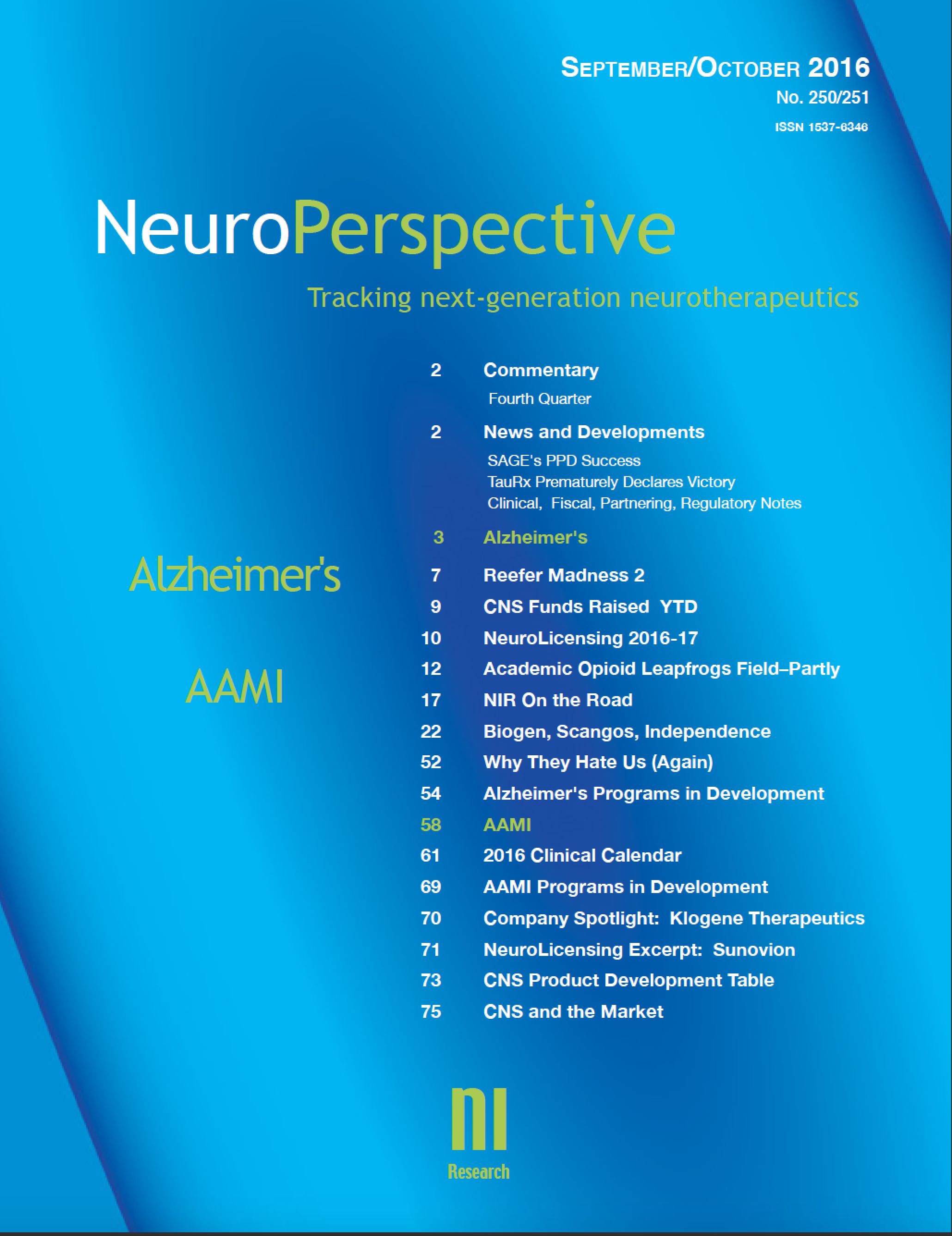
The September/October issue of NeuroPerspective features our comprehensive annual review of the Alzheimer’s space, including a review of the current conceptual trends vis-a-vis pathophysiology and therapeutic targets. In particular, for 2018 there is an expanded assessment of neuro-immunology as it pertains to Alzheimer’s, including infection models of AD and tactics for modulating microglial activity. The subtitle for the review is ‘Circular Illogic‘, because despite our past observations of the need for recalibration in the pursuit of AD, there is still more investment in amyloid-centric programs than the data warrants.
Among the 150+ programs are assessed are those from: AbbVie, Alector, AC Immune, AgeneBio, Allergan, Alkahest, Anavex, Asceneuron, Axon-Neuroscience, Biogen, Cognition Therapeutics, Cortexyme, Denali, Eisai, E-Scape, Genentech, Intra-Cellular, JNJ, Karuna, Klogene, Lilly, Lundbeck, Merck, Novartis, Oryzon, Pfizer, Probiodrug, Proclara, ProMIS, Roche, Takeda, United Neuroscience, and Voyager. Alector is the focus of the Company Review, sidebars include coverage of the current state of the AD Biomarker art and an overview of the POC timelines for major AD programs.
The Sept/Oct issue also includes a full review of Frontotemporal Dementia (FTD), including an evaluation of the complex heterogeneity within this umbrella category, with marked divergences in genotype and phenotypic signs. FTD programs are evaluated, including those from AbbVie/Alector, Biogen, Axovant/Benitec, Aquinnah, and Wave Life Sciences/Takeda.
75 pages.
Read More
NI Research has released the July/August 2018 issue of NeuroPerspective. Its two review sections provide a mid-year review of the neurotherapeutics sector, including succinct summaries for over 80 companies in the neuro-space, and a comprehensive review of Autism.
At midyear 2018, the neuro space has been impressively resilient in terms of partnering and funding, with 2018 on pace to eclipse 2015 as the best year in the 2004-present period for both. Investment trends continue on-track, with partners ardently pursuing disease-modifiers in neurodegeneration, institutional investors taking a somewhat more conservative and diversified course amongst the four major therapeutic supra-classes, though Psychiatry is making something of a comeback. There have been impressive clinical datasets, from Roche-PTC Therapeutics and Roche-Ionis, to name two, and more ambiguous, arguably disappointing results, such as those from JNJ on esketamine. The CGRP premise has advanced in migraine, both its injectable and oral constituents, but the search for nonopioid analgesics to supplant the traditional but highly problematic opioid standards has been a challenging one. AbbVie and Biogen exemplify two large companies making substantial and creative investments in neuroscience while Pfizer’s retreat into venture funding, and Teva’s vaporization of its nascent neuro R&D programming, are embarrassments.
The therapeutic area reviewed in full is Autism, the one major disorder that is showing a distinct increase in its prevalence rate. It is the domain where genotyping and digitally-enhanced phenotyping are being combined to provide improved, validated parsing of what is otherwise an enormous but heterogeneous population. It is also the context where novel mechanistic approaches, from the vasopressin-oxytocin axis to the burgeoning area of gut-brain microbiome disruption, may make their mark first.
The Autism review includes programs from Roche, Servier, Azevan, Neuren, Simons Foundation, as well as numerous academic research programs, and features a capsule review of Axial BioTherapeutics.
Read More
The May/June 2018 issue of NeuroPerspective takes NP into a world of internal contradictions, in an issue that features reviews of Addiction and Anxiety. Addiction, in view of the American ‘Opioid Epidemic’, receives enormous press coverage in the US, but a relatively paltry slice of the federal funding pie, and a pathetically infinitesimal portion of pharma’s R&D outlays. There is a surfeit of hand-wringing and blame-placing, but little more than window-dressing when it comes to putting actual resources to work. NIDA has done exemplary work in keeping the lights on for Addictions research, but hardly at the scale necessary given the scope of the disorder. Crowd-funding Narcan is not a strategy, it is a illustration of individuals trying to compensate for societal negligence.This is the first time that NIR has reviewed the field of Addiction since the November/December 2015 issue, and during that time, the ‘Opioid Epidemic’ in America has finally percolated into public awareness. In so doing, it has moved opioid addiction from its former subsistence at the murky margins of contemporary society right to the core, reflecting the decimation of neighborhoods and families across the full spectrum of socioeconomic strata. This review details the neurophysiology and therapeutic approaches to opioid addiction, and its substance abuse siblings: Alcohol, Nicotine, and Stimulants (cocaine and methamphetamine). Therapeutic programs from Addex, Braeburn, Embera, Indivior, MediciNova, Opiant, and Savant are among those reviewed in the review.
Anxiety is similarly underaddressed given its prevalence: The number of individuals in the US, EU, and Japan with anxiety disorders is in the many tens of millions. The reality is that the majority of those with anxiety disorders suffer through them, because the available treatment options are either inadequate (pharmacotherapy) or under-funded by payors (psychotherapy). And the pharma industry? There is hardly any Big Pharma activity in pursuit of anxiolysis, and not much more than that from small biotech/biopharm companies. Programs from Addex, Aptinyx, Azevan, Bionomics, Idorsia, JNJ, Marinus, and SpringWorks are among those covered, with this work at times overlapping with the work on PTSD therapeutics covered in the March/April issue.
The May/June issue also discusses Biohaven’s rimegepant results; Alkermes and the FDA; and the ‘Billions’ invested by Novartis and Biogen in AveXis and Ionis. Company reviews for Opiant and Bionomics are included.
Read More